What is professional
Professional logo design is a process carried out by a graphic designer to create a logo that is suitable for a company. Let’s first look at the characteristics of a good logo.
The logo is the key element in corporate brand identity. It is the face of your company and creates the first impression.
original and emotional.
This goal can be achieved very well with the help of typography and color alone—they can express the traditional, the modern, the institutional, the friendly, the ambitious, the gentle, the changing, the stable, etc. When a graphic symbol is added, it should reinforce the emotion and emphasize the differences.
is not trivial.
Customers often ask us to visualize aspects of their company’s activities in their logo. Even if they are stylized and well executed, graphic symbols that refer to specific attributes or products of the business often give a simplistic and overloaded appearance that is difficult to remember, blocks brand identity, and reduces its lifespan.
Imagine an IT services startup that “wants” to have a computer in its logo. Computers from 10 years ago are different from today’s computers. It will also be different from computers created 10 years from now. Not only will the logo look outdated, but it will also be very limiting in terms of new business opportunities – mobile applications, smartphones, intelligent architectures and networks, etc.
Sometimes more straightforward graphic symbols can be an acceptable approach – in the specific case of traditional or artisanal fields of activity.
A logo is not just a sign, it is a symbol of an organization. Symbols do not explain, they identify.
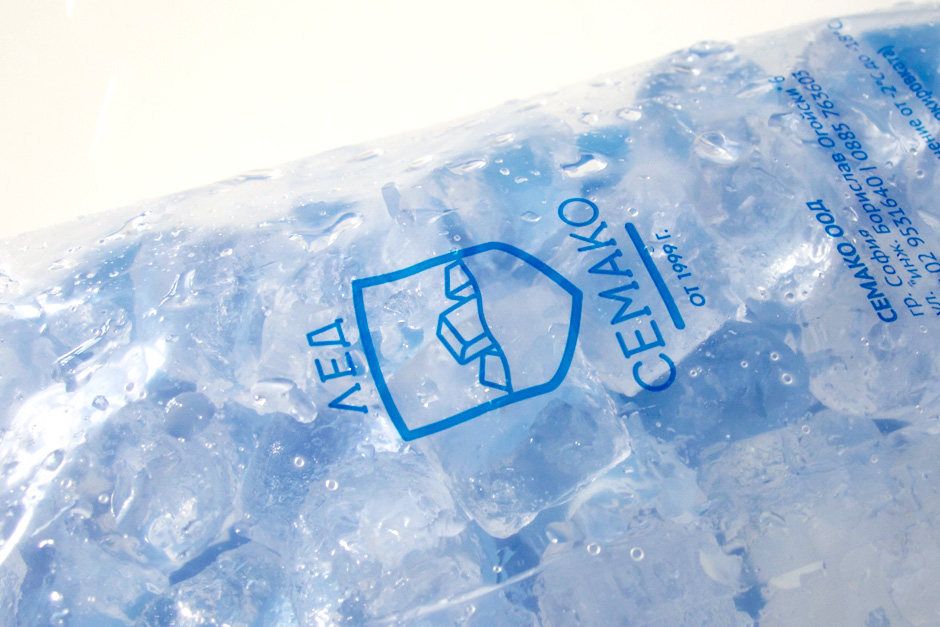
However, searching for specificity or object associations in the logo cannot convey the company’s values. Something more is needed. In the logo design below, ice cubes are represented in a family crest, and the typography has a retro and traditional feel.
a process
Each concept and logo variant is the result of an open, creative, yet structured work process. It may vary for each graphic designer, but always includes phases of familiarization, research of competitors’ visual identity, sketching and testing of concepts, digital logo development, etc.
Step 1 – Get to know and brief
When reviewing a visual identity project in our initial brief, we try to gather three types of information:
- Subjective – basically related to customer preferences and vision of the company.
- Marketing – for the market in which you operate, for potential customers, for competitors; for distribution methods or market history (if the project is for redesign and brand repositioning);
- Technical – how, where, on what media, and in what sizes the logo will be used;

Step 2 – Research
Our graphic designer researches visual identities for the sector and competitors. He will identify their strengths and weaknesses and develop guidelines for style and differentiation.

Step 3 – Conceptual phase, sketching, and testing
This is the creative part of the logo design project. The graphic designer develops graphic concepts with pencil and paper or directly on the computer. The previous stages of the project allow each conceptual idea to be evaluated against clearly defined criteria.
Step 4 – Digital development of the logo
Once we have graphic concepts that are suitable and meet the criteria, they need to be digitally created on a computer in Adobe Illustrator and in vector format. Final adjustments are made to typography, colors, and spacing. We usually present the client with two completed logo concepts, along with a document explaining our reasoning and logo variations for different uses.
good logo design
Every graphic designer will give you slightly different definitions of good logodesign.
We can simplify them into three fundamental criteria we have in Zen Studio:
- Appropriate for the customer and their sector of activity – form, concept, emotion. For example, the aesthetics of a logo for sporting goods should radiate dynamism, a logo for a fashion brand – elegance and modern typography, etc.;
- Clean and simple, so it can work effectively and adaptively across a wide range of sizes and media;
- Memorable – although the logo design is clean and simple, it should also be unique and distinctive so that it is easy to remember.
visual brand identity
Brand identity (a.k.a. Corporate style or Visual identity) is the development of graphic rules and a graphic environment for the company’s communication tools. It defines the use of the logo for different media, corporate colors (primary and secondary) and typography (fonts). Depending on the nature of the business and communication, the project may include the creation of templates for business cards, letterheads, presentations, websites (web charts) brochures, catalogs, packaging, and more.
These graphic rules allow the company to communicate to the market in a homogeneous visual environment, which over time enforces its brand recognition and builds its visual identity. The client receives a brand identity and corporate style guide. This is a document that is provided to every graphic or web designer to ensure compliance with the established corporate style.
The logo already has its purpose – to be attractive, easily understandable, recognizable, original, durable, consistent…
Let’s give it a chance to surprise us.