



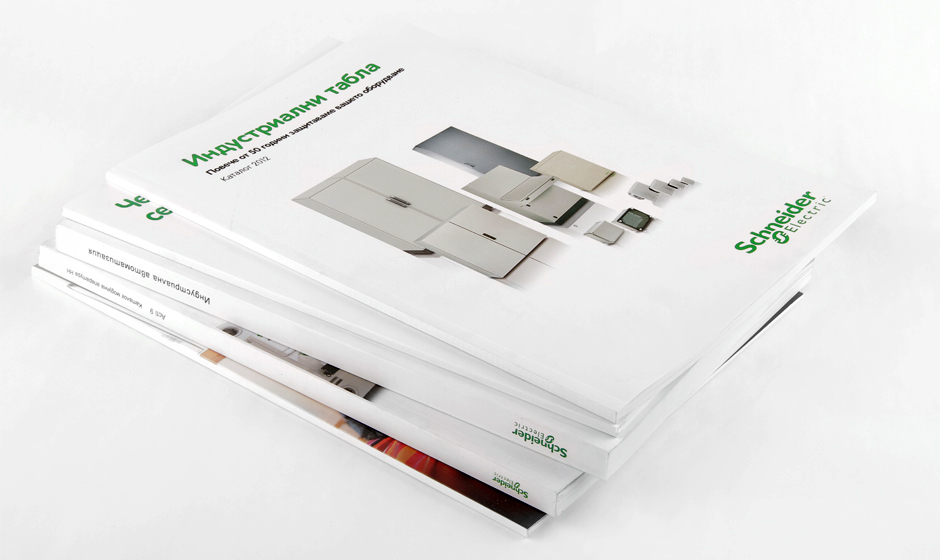
Do companies need printed catalogs in the digital era?
Digital platforms are fast and accessible. However, print offers distinct competitive advantages that screens cannot replicate. The decision to invest in a printed catalog depends on your sales model, but for B2B sectors, the benefits are clear.
The power of focus
The internet is a distraction engine. When a client views your products on a website, they are one click away from your competitor, an email notification, or a social media feed. A printed catalog captures full attention. There are no pop-ups and no open tabs. The reader engages strictly with your content. This focused environment is critical when selling complex technical products that require study, understanding the benefits and comparison.
Physical presence and permanence
A website disappears when the browser closes. A printed catalog claims physical real estate on a procurement manager’s desk or in a workshop. It serves as a constant visual reminder of your supplier status. In technical fields, engineers and mechanics often prefer a physical reference guide they can use on-site, without needing a device or an internet connection. A greasy workshop is not a friendly environment for an iPad, but a durable catalog works perfectly.
Sales tool for customer meetings
In a person-to-person sales scenario, a catalog (similar to brochures) is a collaborative tool. It allows the salesperson and the client to view a page together, point to specific technical specs, and make notes. It facilitates a conversation rather than a presentation. Scrolling through a screen often creates a barrier; turning pages creates a shared experience.
Brand authority
Print signals permanence and stability. Investing in a substantial, high-quality catalog suggests that your company is established and your product line is stable. In industries where long-term support is crucial, this builds trust. A high-quality print job implies high-quality products.
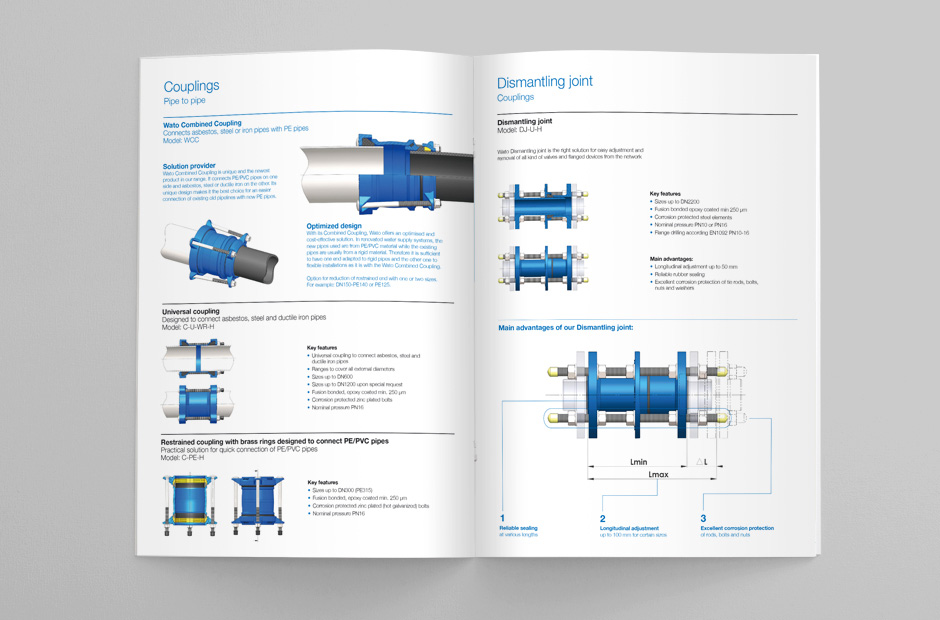
Who benefits most from professional catalog design?
Not every business requires a printed catalog. A software company or a fast-fashion retailer might rely entirely on digital feeds. However, for businesses dealing with physical goods, complexity, and professional buyers, the catalog is often the primary sales engine.
Generally, a catalog is essential for companies that fit one of these three profiles:
- High SKU count: You sell hundreds or thousands of product variations (sizes, materials, ratings).
- Technical complexity: Your products require data sheets, compatibility charts, or dimensional drawings to be understood.
- Professional Procurement: Your clients are B2B buyers (engineers, architects, purchasing managers) who buy in bulk or repeat orders.
Here are specific examples of industries where catalog design is not a luxury, but a must:
Industrial manufacturing and engineering components
This is the most common sector for technical catalogs.
- Product examples: Fasteners, valves, hydraulic pumps, electronic components, electrical devices, bearings, system architectures …
- The need: An engineer selecting a valve needs to see flow rates, pressure ratings, materials, and dimensional drawings side-by-side.
- The catalog role: It acts as a technical manual. The design must prioritize data tables and schematic diagrams over “lifestyle” photography. Precision and error-free data are the main goals.
Wholesale and distribution
Distributors often aggregate products from multiple brands into one cohesive offer.
- Products examples: Office supplies, safety gear (PPE), cleaning chemicals, electrical supplies.
- The need: Buyers for large facilities need to order everything from pens to janitorial carts in one go. They scan pages quickly to find item codes.
- The catalog role: Efficiency. The layout must be dense but legible, allowing the buyer to find the product code and price instantly. Thumb indices and color-coding are critical here.
Construction and building materials
- Product examples: Tiles, flooring, lighting fixtures, architectural hardware, insulation, building systems.
- The need: Architects and contractors need to see both the aesthetic appeal and the technical specifications (fire ratings, durability, installation methods).
- The catalog role: A hybrid of inspiration and information. High-quality images show how the product looks in a room, while adjacent technical sections explain how to install it. These catalogs often live in architectural libraries and contractor offices for years.
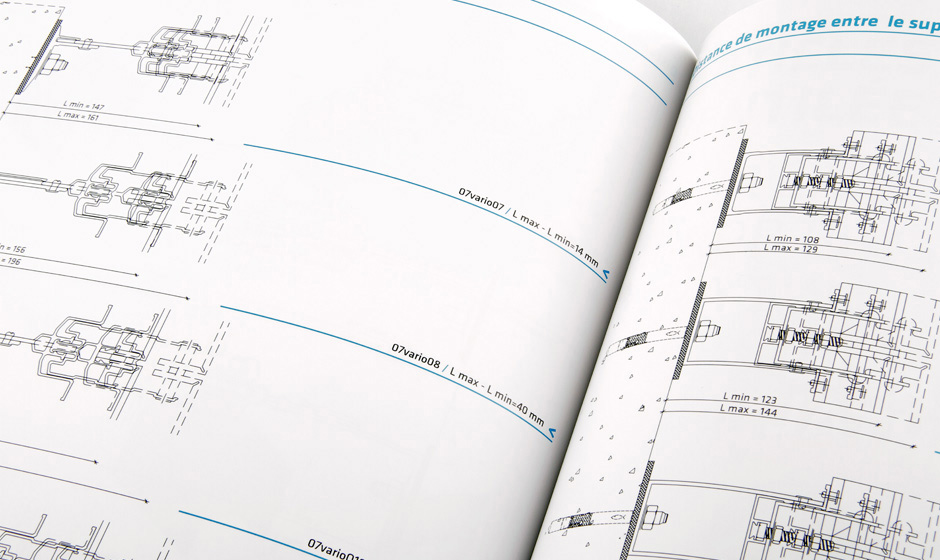
Creative services and the catalog design process
Creating a catalog is a logistical and artistic challenge. It requires a balance between visual appeal and rigid structural organization. At Zen Studio, we treat catalog design as an engineering project as much as a creative one.
Our process ensures accuracy, readability, and a streamlined path to the printing press.
Phase 1: Workflow strategy and data organization
Before we draw a single line, we analyze the content. This is the most critical step for technical catalogs.
- Data audit: We review your product databases, Excel sheets, and technical specifications. We identify inconsistencies and determine how to standardize data presentation.
- User experience (UX) for print: We determine how the user will find a product. Will they search by category, application, or part number? We design navigation systems – color-coded sections, thumb indexes, and clear tables of contents (to speed up this search).
Phase 2: The grid and layout design
Consistency is key. We create a “master grid” for each page type that dictates where every element sits on the page.
- Visual hierarchy: We design layouts that guide the eye. The product image, the headline, the description, and the specification table each have a distinct weight.
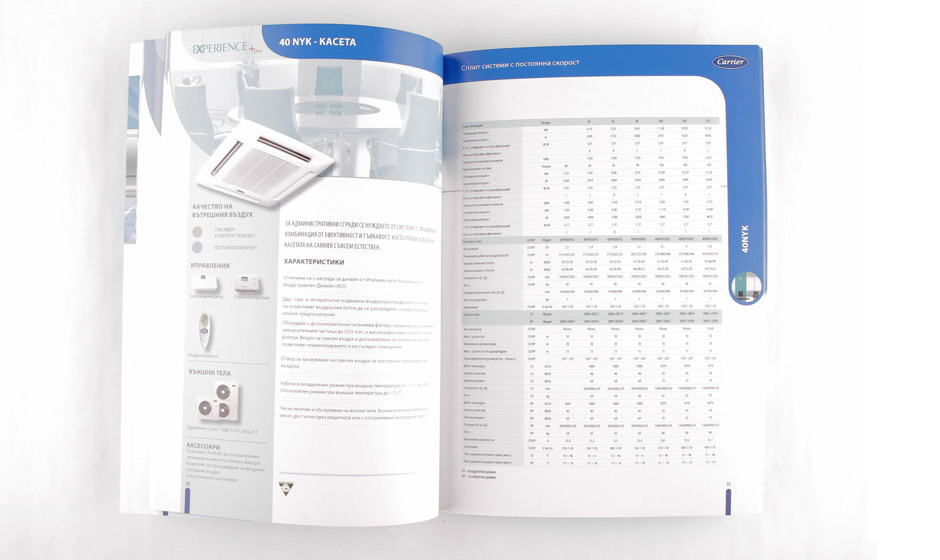
- Technical tables: This is a specific area of our know-how. Technical data must be legible. We design tables that are easy to scan, using alternating row colors, clear headers, and appropriate font distinctiveness. We ensure complex specs are not just a wall of text.
- Automation: For very large catalogs, manually placing every comma is a risk. We utilize data-merge tools and scripting within professional publishing software like InDesign. This links your spreadsheet data directly to the layout. If you update a price in your Excel file, it updates in the design. This reduces human error significantly.
Phase 3: Image management, pre-press and print management
A catalog often contains hundreds or thousands of images. Imagery and colors on the screen look different from ink on paper. Here, Zen Studio’s technical expertise is key to achieving the required quality.
- Quality control: We check every image for print resolution (300 DPI) and color mode (CMYK). We standardize product photos. If one product has a grey background and another has white, the catalog looks messy. We clip backgrounds and adjust lighting to ensure uniformity across the entire product range.
- Color management and paper choice: We apply the correct color profiles for the specific paper and printing machine being used. This ensures your brand red prints as red, not orange. We help you choose the right paper weight and finish. A technical catalog might need thinner, uncoated paper to keep the weight down and allow for writing notes. A luxury furniture catalog needs thick, glossy stock.
- Binding: We choose a binding method – perfect binding (glued spine), saddle stitch (stapled), or spiral binding (lays flat) to deliver a durable and cost-optimized product.
- Press check: We do not just send a file and hope for the best. We communicate with the print house, check digital proofs, and if necessary, attend the press start to approve the first physical sheets.
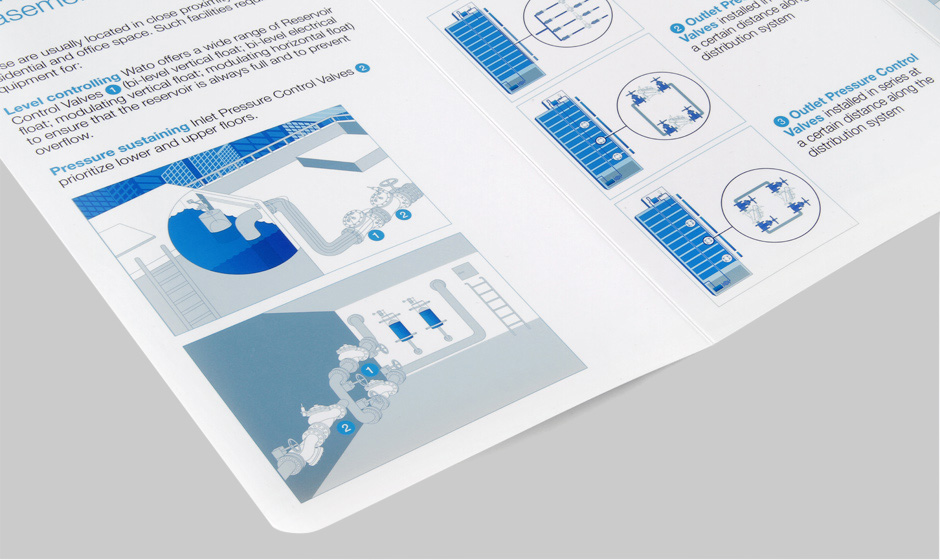
Digital PDF Catalog vs. Printed Catalog
We don’t advocate for print, we understand the necessity of digital tools. Zen Studio always produces a digital version of your catalog. However, the two formats serve different roles and require different design considerations.
The printed catalog – high cost per unit, but high impact per unit.
- Role: The heavy lifter. Used for closing deals, deeply researching specs, and establishing brand dominance.
- Design Focus: High-resolution images, CMYK color space, static navigation (page numbers, indices). It is hand-delivered or mailed.
The digital PDF catalog
- Role: The rapid response tool. Used for quick sharing, email marketing, and website downloads.
- Design Focus: Optimized images and file size for fast loading. Color space optimized for screen viewing.
- Interactivity: This is where the digital version shines. We do not just export the print file. We enhance it with hyperlinked contents (users click a category in the index and jump instantly to the page), searchable text, external links – ex. clicking a product code can link directly to your e-shop for immediate purchase.
How much does catalog design cost?
At Zen Studio catalog design is a service priced on a project-by-project basis, not a fixed rate. Our pricing takes into account three main factors:
- Design complexity: Does the project require a simple, brochure-style layout, or a complex grid for dense technical tables?
- Pre-press workload: The number of SKUs, the necessity of data automation (data merging), and the validation of hundreds or thousands of specifications.
- Additional asset creation: The need to create new technical drawings, illustrations, copy, or extensive retouching of source imagery.
Despite the individual approach, we offer a transparent basic cost estimate per page. This structure allows us to reduce the unit cost for larger volumes, which optimizes your budget.
Basic catalog design cost estimate
| Catalog volume | Price per page |
| Up to 32 pages | 40 EUR/page |
| Up to 100 pages | 30 EUR/page |
| Over 100 pages | 25 EUR/page |
Important Notes:
- The prices listed are baseline estimates and do not include additional services such as photo manipulation, creation of technical drawings, or copywriting.
- Our final offer is prepared after a detailed review of your product database and overall content requirements.
Contact Zen Studio to discuss the specifics of your project.
Conclusion
A catalog is a substantial investment of time and resources. It requires a partner who understands not just graphic design, but data structure, print logistics, and sales psychology.
Zen Studio delivers this balance. We handle the complexity of technical catalogs so you can focus on selling the products inside them. Whether you need a 20-page or a 500-page catalog, we bring order, function, clarity, and professional quality to your product presentation.